
Loading...
Serving Longview, TX and surrounding areas. (430) 267-1978
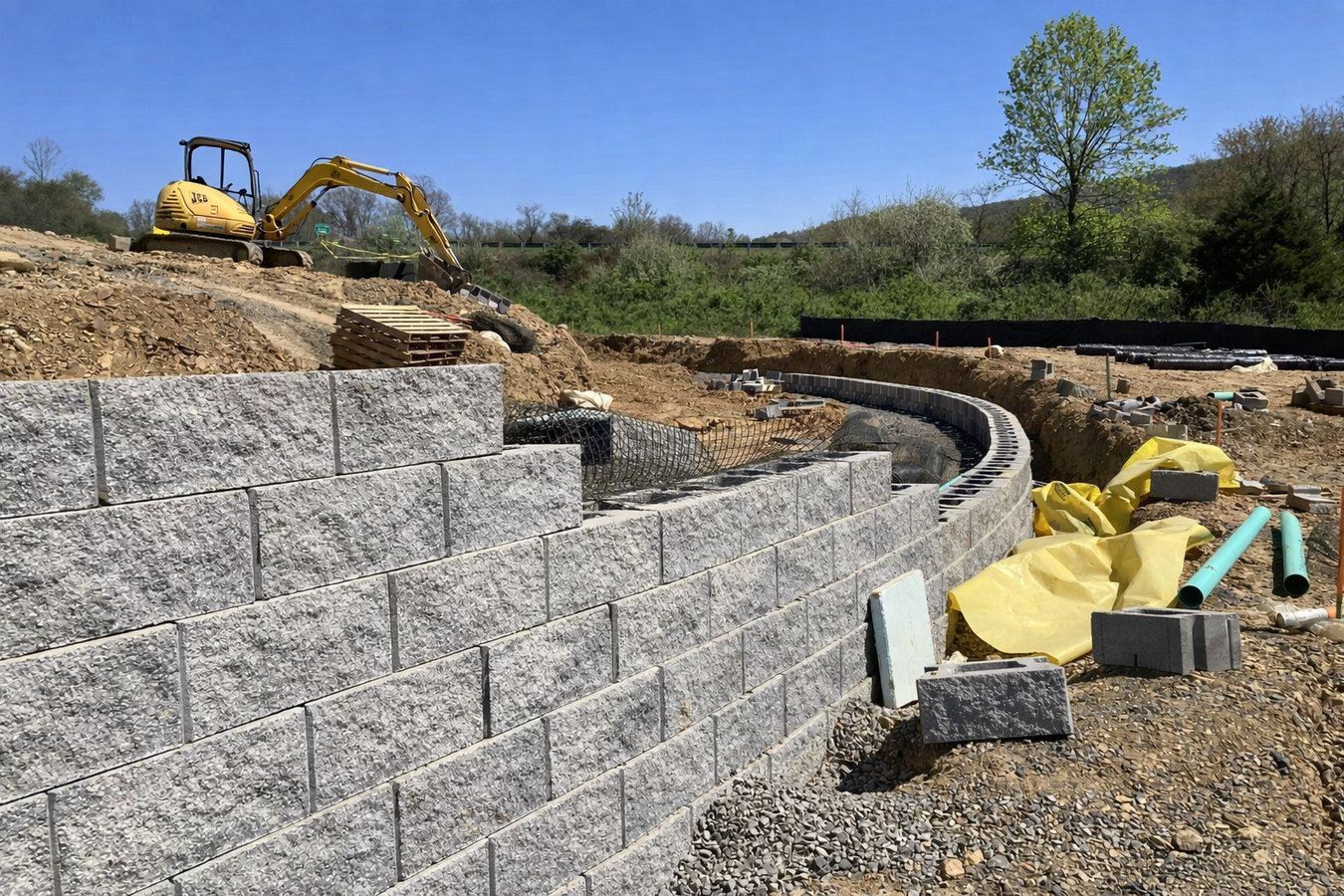
East Texas clay soil and heavy rain will keep washing your yard away until you put a proper wall in. We build retaining walls that handle local conditions and pass city inspection.
Retaining wall construction in Longview, TX holds back sloped soil using concrete block, natural stone, or poured concrete, most residential projects taking one to five days depending on wall height, length, and site conditions.
The answer is slope plus clay soil plus nearly 47 inches of rain per year - a combination that erodes unprotected yards a little more every season. A retaining wall stops that cycle permanently by holding the soil in place. Many of Longview's established neighborhoods were built on gently rolling terrain, and walls are a common feature on properties throughout the city. If you also need to address the finished surface above or below the wall, many homeowners pair a retaining wall project with masonry restoration on nearby structures or add concrete block walls for additional yard definition.
The part of the wall you cannot see - the drainage system buried behind it - is what determines whether it lasts 40 years or fails in five, something any experienced retaining wall contractor will tell you. Good base prep and a proper drainage layer are non-negotiable in this climate.
If you notice bare patches, ruts, or small gullies forming on a sloped area of your yard after a heavy rain, your soil is eroding. In Longview, where storms can be intense and clay soil does not absorb water quickly, this kind of erosion can get worse fast. A retaining wall stops the cycle by holding soil in place permanently.
If an older wall is starting to tilt forward, develop cracks along the face, or push outward in the middle, it is under stress it was not designed to handle. This is common in Longview's older neighborhoods where walls were built decades ago without modern drainage. A leaning wall will not fix itself - and if it fails, it can damage whatever is downhill from it.
If rainwater consistently runs toward your house and sits against the foundation, a retaining wall or grading correction may be the right fix. Longview's heavy rainfall and clay soil make this a common problem - water that cannot drain away has nowhere to go but against your home. Left alone, that moisture exposure leads to foundation problems over time.
If part of your yard is too steep to mow safely, use for a patio, or let children play on, a retaining wall can create a level terrace. Many Longview homeowners use retaining walls to reclaim sloped backyard space for gardens, outdoor seating, or play areas - adding usable square footage without adding to the home itself.
We build retaining walls from concrete block, natural stone, and poured concrete across Longview and the surrounding area. Every project starts with the right base - excavated deep enough for local clay soil, properly drained, and backfilled in compacted layers. Walls under four feet can often be permitted and built straightforwardly. Taller walls require engineer-reviewed designs before the City of Longview will issue a permit, and we coordinate that process as part of the project scope.
For clients with existing walls showing early signs of failure, we also assess and repair - resetting displaced blocks, clearing blocked drainage outlets, or rebuilding sections that have moved beyond repair. Projects that also involve a large masonry restoration scope, or homeowners who want to combine a retaining wall with freestanding concrete block walls for yard privacy, can scope all of that together to reduce scheduling and mobilization costs.
The most popular and cost-effective choice for Longview homeowners - durable, widely available, and suited to residential slopes of most heights.
Best for homeowners who want a high-end, distinctive finish that blends naturally into heavily wooded East Texas yards.
A strong option for taller walls or commercial-adjacent applications where maximum structural capacity is needed.
Suited for existing walls with leaning, cracking, or drainage failure - assessed and repaired to extend wall life where replacement is not yet necessary.
Longview sits on heavy clay soil that swells when the ground gets wet and shrinks in dry spells. That constant movement puts stress on retaining walls year after year, and a wall built without accounting for it will fail faster than it should. Longview also receives close to 47 inches of rain per year - intense storms that can drop several inches in a single day are not unusual here. Drainage built behind the wall is essential, not optional, in this climate. The National Concrete Masonry Association sets design standards for block wall construction that specifically address drainage and base requirements - guidelines we follow on every project. Homeowners in White Oak and Gladewater deal with the same soil and rainfall conditions as Longview, and our approach to drainage and base depth is consistent across the region.
Longview's older neighborhoods were developed on gently rolling terrain, and mature pine and oak trees are common throughout residential lots. Tree roots can grow into the back of retaining walls over time, pushing blocks out of alignment or cracking poured walls. If your wall will be built near large trees, we factor that into the design - root pressure is a real consideration here that does not come up in newer, less-wooded subdivisions. The Mason Contractors Association of America training resources we draw on include specific guidance on wall behavior near established root systems.
We visit your yard in person - most retaining wall projects cannot be quoted accurately over the phone. We look at the slope, soil, and drainage situation and give you a written estimate within a few days.
For walls that meet the City of Longview height threshold, we submit the permit application to Development Services before any work begins. You do not need to visit any office or fill out any forms yourself.
We dig to the correct depth, level the base, and install the drainage layer - gravel and perforated pipe - behind where the wall will sit. This is the most important part of the job, and it happens before a single block goes in.
We build the wall from a buried base course up, backfill in compacted layers, and schedule the city inspection for permitted projects. We walk the finished wall with you and explain drainage outlet locations before we leave.
We respond to all new inquiries within one business day. Expect some disruption during construction - equipment in your yard, soil being moved, and temporary mess near the work zone are normal. Most crews clean up at the end of each day.
Free written estimate. We come to your yard, look at the slope and soil, and give you a real number before any work begins.
(430) 267-1978Longview averages close to 47 inches of rain per year, and a retaining wall without proper drainage will eventually fail from water pressure behind it. We install gravel and perforated drain pipe behind every wall as a standard part of the job - not an optional upgrade. That hidden system is what separates a wall that lasts from one that leans after three wet winters.
East Texas clay swells and shrinks with every rain cycle, and a base that is not deep enough for those conditions will allow the wall to shift and crack over time. We adjust excavation depth and backfill compaction for every Longview project based on the specific slope, soil, and wall height involved. There is no standard spec that works for every yard here.
The City of Longview requires permits for walls above a certain height, and we handle the full process - application, coordination with Development Services, and final inspection scheduling. You get documentation that protects you if you ever sell the home, and you never have to visit a city office. A contractor who suggests skipping permits is transferring that risk to you.
We have completed retaining wall projects in Longview's established neighborhoods - the kinds of mature, wooded lots with rolling terrain where walls are common and the soil conditions are well understood. We are happy to point you to completed projects nearby so you can see the finished work before you commit.
Every project starts with a site visit and a written estimate - not a phone guess - so you know exactly what you are agreeing to before anyone picks up a shovel. You can verify contractor standing at any time through the Texas Department of Licensing and Regulation. We carry general liability insurance on every job - proof available on request.
Restore aging masonry on your home or outbuildings - addressing deterioration that often goes hand in hand with drainage and soil movement issues.
Learn MoreAdd freestanding concrete block walls for yard privacy or property separation alongside or independent of your retaining wall project.
Learn MoreLongview's rainy season does not wait - schedule your project now and stop the erosion before the next big storm.